Skip to content
May 14, 2026
- China added 34 GW of nuclear capacity over the past decade versus a single new plant in the U.S., and is on track to overtake both the U.S. and France as the world’s top nuclear producer within ten years.
- Beijing’s 15th Five-Year Plan prioritizes advanced reactor development, domestic nuclear fuel independence, and expanding China’s nuclear footprint across emerging markets via the Belt and Road Initiative.
- Both countries are racing toward next-gen nuclear tech — SMRs and commercial fusion — but China’s state-backed spending and regulatory agility give it a structural edge Washington can’t easily close.
China and the United States are facing off for nuclear energy dominance on the world stage. The United States has the world’s largest nuclear energy production capacity, but China has the fastest-growing nuclear fleet. China’s 15th Five-Year Plan (15FYP), released back in March, sets out a bold nuclear power strategy for Beijing, aiming to continue to build the nation’s own nuclear fleet while also intensifying China’s presence in international nuclear energy markets, particularly in emerging economies.
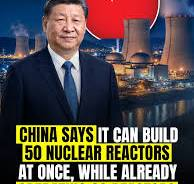
Meanwhile, in the United States, the Trump administration is also rushing to loosen regulations on nuclear power development in order to revive the nation’s aging and slowing nuclear power sector. While the United States has added just one nuclear plant in the last decade, China added a staggering 34 gigawatts of capacity over the same time period. As a result, China is set to overtake the United States (and France) to become the world’s single biggest producer of nuclear energy within the next ten years based on current projections.
Beijing’s latest five year plan shows that China has no intentions of slowing down. “With innovation and security as its leading themes, the latest FYP illuminates how nuclear energy underpins multiple strategic priorities for China in the context of not only energy security but also technological innovation and global engagement,” the Center for Strategic and International Studies (CSIS), a nonprofit policy research organization and bipartisan think tank recently reported.
The CSIS summarizes China’s recently unveiled nuclear power strategy for the years 2026 through 2030 and compares the rhetoric around nuclear power to previous five year plans. Based on this analysis, the report highlights seven key takeaways:
- China is investing heavily into nuclear energy as a part of an ultra-diverse energy portfolio in order to shore up domestic energy security and resilience.
- The Chinese government is propping up the nation’s nuclear sector in a big way, funding manufacturing as well as research and development of next-gen nuclear energy models like small modular reactors.
- While China is intent on expanding its nuclear energy influence on a global scale, its exports of nuclear reactors are struggling – the country has seemingly abandoned plans for exporting large-scale reactors, and is apparently delaying the rollout of modular models.
- While China’s desire to build up nuclear energy supply chains in other countries is central to its own interests in terms of energy security and (geo)political influence, Beijing is spinning this strategy as a contribution to energy security in poor countries in Global South under the banner of China’s Belt and Road Initiative, a decadeslong development/soft-power-building infrastructural program.
- China is focused on developing advanced nuclear reactors as a key priority of the domestic nuclear program, with particular attention to new reactor models that use less water and rely on alternative fuels, thereby reducing the sector’s resource needs as well as its dependence on nuclear fuel imports.
- Speaking of those nuclear fuel imports, Beijing’s reliance on them means that China’s trade relationship with Russia remains critical to the country’s energy strategy – a dynamic that Beijing is eager to shift.
- Finally, we can expect a major research and development push toward unlocking commercial nuclear fusion, the ‘holy grail of clean energy’, building upon the long list of fusion breakthroughs that Chinese labs have already been stacking up.
The United States’ nuclear energy ambitions are extremely similar to those laid out by China in March. The Trump administration is eager to “produce lasting American dominance in the global nuclear energy market” and is taking a Chinese approach to this goal, by issuing executive orders to reshape the national nuclear energy regulatory framework. The Trump administration is likewise bullish on developing next-gen nuclear reactors and nuclear fusion technology on its own home turf in order to stay at the technological vanguard of the nascent sector. Finally, the United States is also fighting to free itself from international nuclear fuel supply chains by building up domestic uranium extraction and enrichment capacities.
However, despite similar goals and leadership styles, China is a clear frontrunner in the nuclear energy race over the next few decades. Beijing has simply been outspending Washington for decades, and has the authoritarian ability to continue to prop up the sector without the pesky inertia of checks and balances. But the result of the nuclear energy race between the world’s two biggest economies could end up being a boon for the entire planet, nuclear expansion represents a key tenant of global decarbonization pathways.
Oilprice.com