President Tinubu: We will continue to work to make life better for Nigerians


Everyone is Selling Mindset –Folake Soetan
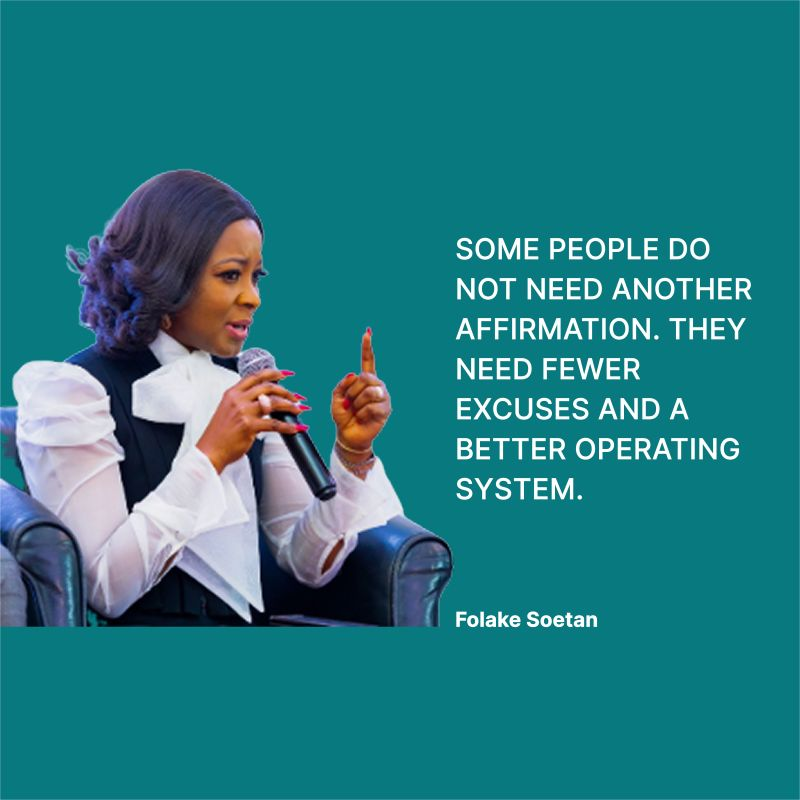
The Cambridge Dictionary defines “mindset” as a person’s habitual way of thinking, beliefs, and mental attitude that shapes how they perceive and respond to life situations. It acts as a cognitive filter influencing behaviors and emotions, often divided into fixed (abilities are static) or growth (abilities can grow) types.
According to Folake Soetan, few are honest about what mindset alone cannot do. That conversation is worth having. An entire industry has been built around thinking differently. People emphasize: – Vision boards – Morning routines – Positive affirmations – Motivational content that feels powerful on Sunday and fades by Monday.
However, performance rarely changes at the level the hype promises. This should force you to have a different conversation with your team.
Gallup notes that 70% of the variance in employee engagement is driven by the manager. Performance doesn’t improve on mindset alone. It rises on standards, systems, and leadership.
A positive mindset without standards becomes comfort. A growth mindset without accountability becomes excuses.
An ambitious mindset without execution becomes delusion. True transformation is not built on what people believe in a moment. It’s founded on what they repeat when the excitement fades.
Mindset may open the door. Discipline is what walks through it. The highest performers are rarely the most inspired. But they’re often consistent.
The future will not be shaped by those who only think the right thoughts. It will be determined by those who do the right things repeatedly, deliberately, and long after motivation runs out.
Appreciating Soetan’s analysis of mindset, Olawande Stephen said the soundbites are compelling. However, could you clarify how they have translated into tangible changes and customer satisfaction in the way Ikeja Electric operates on a day-to-day basis?
As rightly noted in the comments: “Mindset is a trigger, not a driver. Performance comes from repeatable systems: standards define ‘what good looks like’, accountability enforces it and feedback loops sustain it.” With this in mind, it is important to assess outcomes rather than intentions.
Many customers still perceive Ikeja Electric as performing no better than its predecessors, Power Holding Company of Nigeria (PHCN) and Nigerian Electric Power Authority (NEPA) This raises a key concern: beyond stated commitments, where is the measurable accountability?
Customers billed at premium rates expect corresponding service, yet there remains strong evidences of very poor delivery and limited complaint resolution.
Customer service should go beyond collecting complaints; it should ensure timely and effective resolution and delivery of promised quality of service.
Ultimately, the question is: to what extent has there been a meaningful shift in operational culture, service delivery and customer experience at Ikeja Electric?
Culled from linkedin.com